
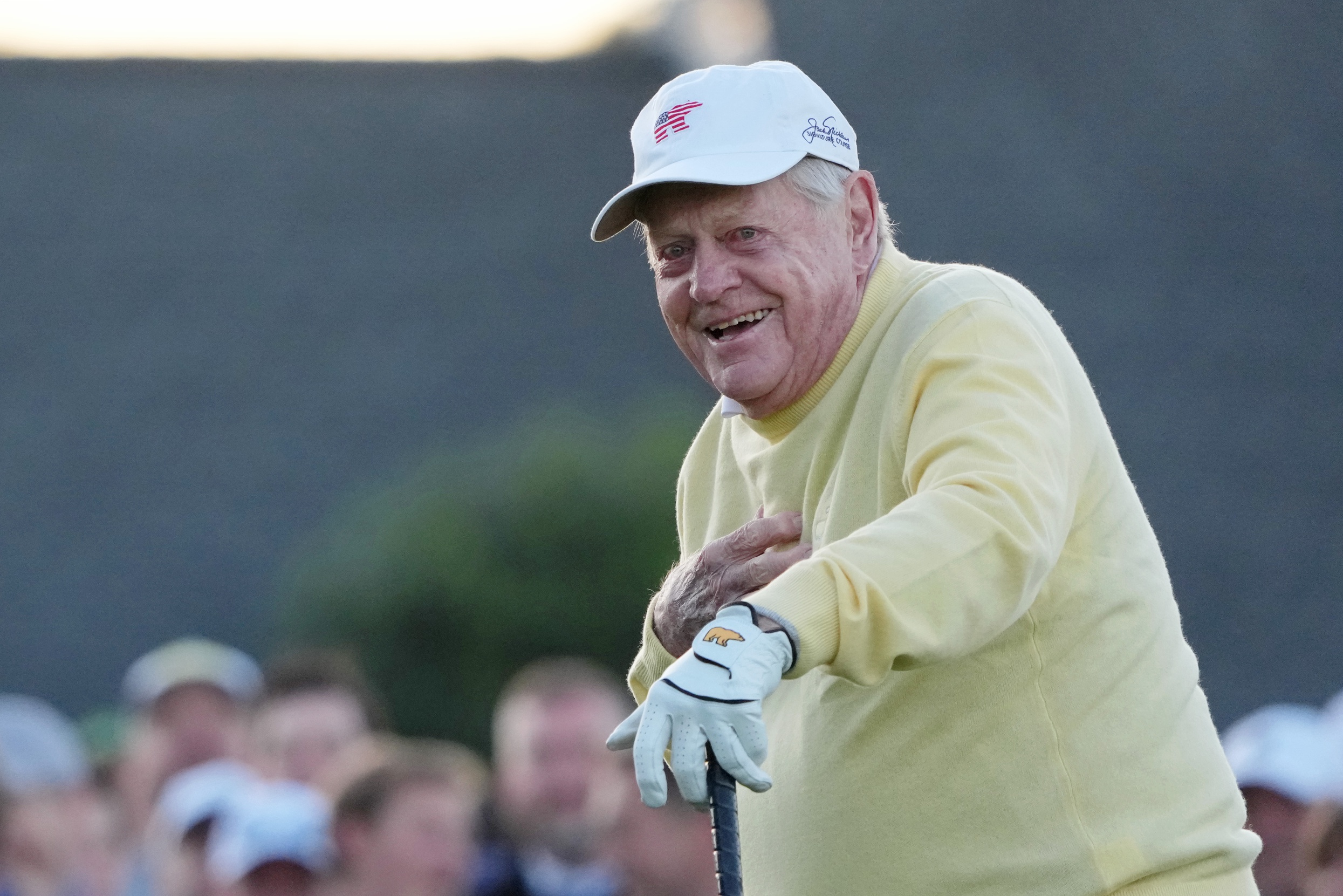
The moment was supposed to be ceremonial, controlled, almost automatic. Masters icon, Jack Nicklaus stepping onto the first tee at Augusta National is a ritual as familiar as the azaleas. Instead, it turned into something far more human.
Nicklaus, now 86, sent his opening tee shot veering off line Thursday morning, a rare misfire in a setting built on precision. The gallery didn’t panic, but there was a noticeable shift; heads turned, bodies leaned, and for a brief second, the crowd became part of the play. The ball sailed safely overhead, avoiding what Nicklaus himself had openly worried about just moments earlier.
A Shot Shaped by Surgery

There was a reason for that concern, and Nicklaus didn’t hide it. He revealed afterward that he had undergone carpal tunnel surgery roughly five to six weeks prior, a procedure that kept him away from the game almost entirely. His preparation was minimal to the point of being nearly nonexistent: one round last year, one more in February, and little else.
That absence showed. Not dramatically, not disastrously, but enough to turn a ceremonial swing into a tense one. Nicklaus admitted he wasn’t sure he could properly hold the club, let alone guide it safely down the fairway. His pre-shot comment to the gallery, asking them to spread out so he wouldn’t “kill anybody”, landed as humor, but it carried a layer of genuine concern.
A Stark Contrast on the Masters Tee
The contrast on the tee only sharpened the moment. Gary Player, 90 years old, delivered a clean drive straight down the fairway, the kind of shot that reinforces muscle memory built over decades. Tom Watson, 76, followed with similar control, even borrowing Nicklaus’ tee in a small, light exchange that underscored the camaraderie of the trio.
Nicklaus’ shot, by comparison, was imperfect but revealing. It showed the limits imposed by age and recovery, but also the willingness to stand there anyway, aware of the risk and the optics, and still committed to the tradition.
Tradition, With a Margin for Error
He didn’t deflect or dress it up afterward. He said plainly that he didn’t hit it well and acknowledged how close it might have been to a problem. Yet he also made it clear that the ceremony still matters to him, that he intends to keep returning to that tee as long as he’s able, ideally with a little more control next time.
For a brief moment, the Masters opener wasn’t about perfection. It was about timing, recovery, and the thin margin between control and chaos, even for someone who once defined consistency in the sport.