

Golf can get complicated almost immediately. You start with one simple goal: learn how to hit a golf ball. Then suddenly you’re hearing about launch angle, spin rate, swing path, attack angle, club fitting, premium golf balls, and how far your 7-iron should go.
A lot of that information is useful. Eventually.
But when you’re just learning the game, trying to understand all of it can turn golf into a technical exercise before you’ve even learned how to make reliable contact.
If I were starting golf today, I’d strip the game down to the basics. Learn how to hit the ball. Get comfortable being on a golf course. Understand how a round works. Figure out what your clubs generally do.
You’ll have plenty of time later to obsess over the details.
Here are five things new golfers should stop trying to do.
Stop Chasing Every Number
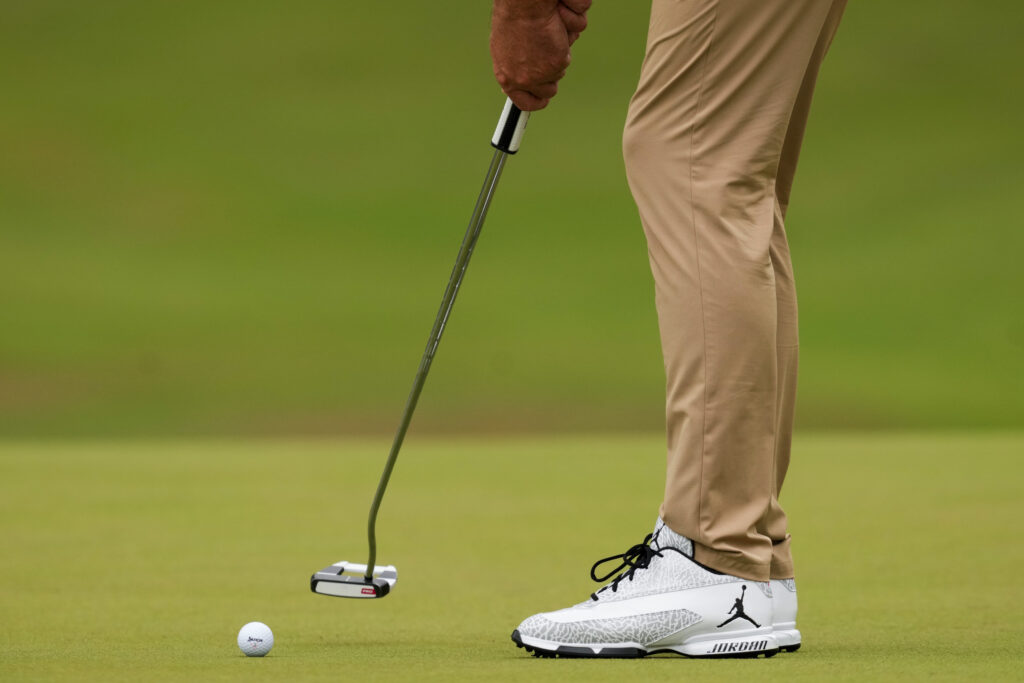
First, stop trying to understand every piece of golf technology.
Modern golf can bury you in numbers. A launch monitor can tell you club speed, ball speed, spin rate, launch angle, attack angle, club path, face angle, and plenty more.
Those numbers can become valuable once you have a repeatable swing. They can help diagnose problems, evaluate equipment, and make practice more productive.
But if you’re struggling to make consistent contact, knowing your driver is spinning at 3,200 rpm probably isn’t the breakthrough you need.
Start with a decent grip and setup. Learn to find the clubface. Get the ball airborne with some regularity. Once you can do those things, the technology starts providing information you can actually use.
Until then, you don’t need to turn every range session into a physics lesson.
Second, stop playing a different golf ball every hole.
This is an easy trap for beginners because golf balls disappear. Sometimes quickly.
If you’re losing two, three, or five balls during a round, spending premium-ball money every time you play can be hard to justify. But that doesn’t mean you should reach into the bag and play whatever random ball comes out next.
Find an affordable, decent golf ball and stick with it.
At this stage, consistency matters more than owning the most expensive ball available. Using the same model gives you a more predictable feel when putting and a better idea of how the ball reacts around the green.
You don’t need the perfect golf ball yet. You need one you can afford to play regularly.
Consistency Beats Maximum Distance
Third, stop trying to hit every club as far as possible.
Distance gets attention, especially with the driver, so it’s natural for a new player to ask, “How far should I hit this?”
A better early question is, “How far do I hit this consistently?”
Suppose your 9-iron goes about 100 yards when you strike it reasonably well. That’s useful information. You now have a club you can begin to trust from that distance.
Trying to squeeze another 10 or 15 yards out of it isn’t nearly as valuable if the harder swing also brings chunks, tops, and wild misses into play.
That doesn’t mean you should make a timid swing or deliberately slow everything down. Make an athletic, committed move. Just don’t treat maximum distance as the objective on every shot.
Speed can be developed. First, learn to make solid contact and keep the ball somewhere you can find it.
Fourth, worry less about your score and more about pace.
Your first rounds of golf are going to involve mistakes. Probably a lot of them. That’s normal when you’re trying to take a range swing onto an actual course with hazards, rough, trees, bunkers, and other golfers around you.
If you shoot 115 instead of 118, the three-shot difference probably isn’t the most important thing you learned that day.
Knowing how to move around the course is.
Learn when it’s your turn. Know where to stand. Have your club ready. Understand where to leave the cart. Pay attention to where the other players are hitting. Be prepared when it’s time to play.
And learn when to pick up.
If you’ve already launched three balls into the woods, you don’t have to keep firing until one survives. Move forward, drop near your playing partners, and continue from there.
If everyone else is putting and you’re still 150 yards from the green after seven shots, picking up the ball isn’t surrender. It’s keeping the round moving.
You’ll have time to count every stroke once you can keep the ball in play more consistently. Early on, learning to maintain pace will make the experience better for you and everyone playing with you.
Forget About the Perfect Golf Swing
Finally, stop trying to build the perfect golf swing.
This might be the biggest one.
A beginner can watch a handful of instruction videos and arrive at the range with eight swing thoughts before hitting the first ball.
Is the takeaway too far inside? Are the wrists set correctly? Did the shoulders turn enough? Is the club shallow enough? Are the hips clearing? Is the weight shifting properly?
Now you’re standing over the ball trying to consciously manage half a dozen body parts in a movement that takes roughly a second.
You don’t need a perfect golf swing to play golf.
You need a functional one.
Learn a reasonable grip and setup. Develop enough consistency to make contact. Pay attention to where the ball goes. As your swing becomes more repeatable, you can begin identifying specific problems and working on them one at a time.
Golf will give you plenty of opportunities to complicate things later.
For now, hit the ball, find it, and hit it again.
You can spend the rest of your golfing life trying to perfect your swing.
Just like everybody else.

