
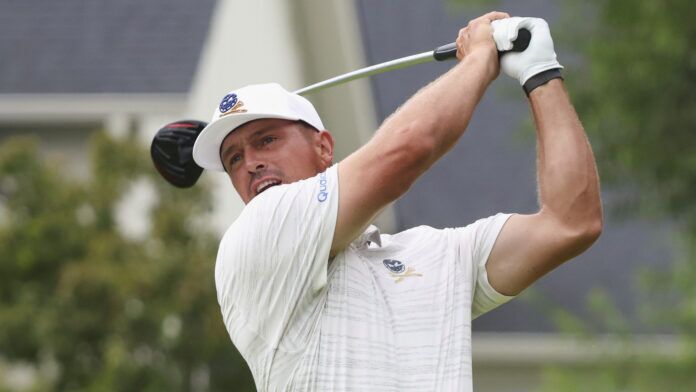
Bryson DeChambeau has broken his silence on the future of LIV Golf as the league faces a mass exodus and legal battles over massive severance demands. While many players flee the circuit following a bankruptcy filing, the two-time Major champion is doubling down on a new iteration called ‘LIV 2.0’. The Saudi-backed league filed for bankruptcy after the Public Investment Fund announced plans to remove funding after 2026. DeChambeau remains optimistic about the league’s direction after a new $300 million investment from BC Partners secured the tour’s future in October.
The 33-year-old spoke candidly on Raj Shamani’s ‘How To Become Elite At Anything’ podcast, addressing the financial collapse that left many teammates stranded. He attributed the failure to ineffective management at the top level rather than the on-course product. “The point of it is that the team golf stuff, I was very excited about,” the 33-year-old said, according to Golf Monthly. “I really care, and I still do care deeply about the team golf stuff. And the top company just wasn’t really managed that effectively. And I know that now… I didn’t know that during the time.”
DeChambeau provided specific financial data to support his view that the team model was viable before the funding dried up. His Crushers GC team generated almost $29 million in revenue last year. He noted that costs for player payments, expenses, and travel totaled $21 million. This left the team with an $8 million EBITDA last year. The financial structure collapsed when the top company went bankrupt, forcing player payments down to the individual teams. “And the teams were doing well, but then all the player payments and everything got pushed down to the teams when they went bankrupt because the top company wasn’t being run effectively,” he explained, according to talkSPORT.
The golfer expressed frustration over the lack of capital that was expected from the original funders. He noted that the players thought there was a lot more money available. “Which, no fault to each other, it’s just we thought that there was a lot more capital that was going to be at play with the guys that were funding it. Yeah. And it didn’t work out.” Despite the bankruptcy, DeChambeau sees a path forward.
Commitment to the New Model
While a cohort of 10 or so golfers, spearheaded by Dustin Johnson, are seeking legal expertise regarding $100 million in severance demands, DeChambeau is committing his future to the league. This stance places him in direct contrast to Brooks Koepka, who walked away from LIV Golf in late 2025 to return to the PGA Tour. Koepka recently made comments suggesting players should avoid DeChambeau, highlighting the friction between those who left and those staying.
The DP World Tour has also slammed shut with news that it will ban players who signed up for LIV 2.0. This creates a complex landscape for DeChambeau and his peers, yet he remains focused on the team aspect of the game. He believes the mismanagement of the original version is a thing of the past. The new investment from BC Partners in October signals a fresh start. DeChambeau’s comments are the first he has made since the announcement of the legal challenges facing the league.
Why the Team Concept Matters
DeChambeau’s defense of the team model centers on the revenue potential he witnessed firsthand. The $8 million profit margin his team achieved suggests the model works when funded correctly. The issue was not the concept but the execution by the funding group. He emphasized that he still cares deeply about the team golf stuff. This sentiment drives his decision to stay while others look for exit clauses. The league is now calling this phase ‘LIV 2.0’, indicating a distinct shift from the previous structure.
The financial transparency DeChambeau offered highlights the gap between expectation and reality. Players had expected significant capital from the Public Investment Fund, but a withdrawal of that funding led to bankruptcy, and DeChambeau acknowledges the top company was mismanaged. He does not blame the players or the teams for the collapse. His focus remains on the product and the future of the league. With the new investment in place, the hope is that the league can avoid the pitfalls of the past.
The immediate future involves navigating the legal fallout from the bankruptcy. Dustin Johnson and others are pursuing legal action for severance. DeChambeau’s commitment provides a stabilizing figure for the new iteration. The league aims to prove that the team format is sustainable. DeChambeau is convinced the product will evolve into a true success story. The success of LIV 2.0 depends on securing consistent funding and managing the league effectively. The $300 million investment is a start, but long-term viability requires more than just capital.
DeChambeau’s stance will likely influence other players who are on the fence about their futures. His detailed breakdown of the finances is a case study for what went wrong. He knows now what he did not know during the time. The league must learn from these mistakes to ensure it “hopefully exists forever.” The next steps involve finalizing the team rosters and securing the schedule under the new ownership structure. The golf world watches to see if the new model can deliver on its promises.

